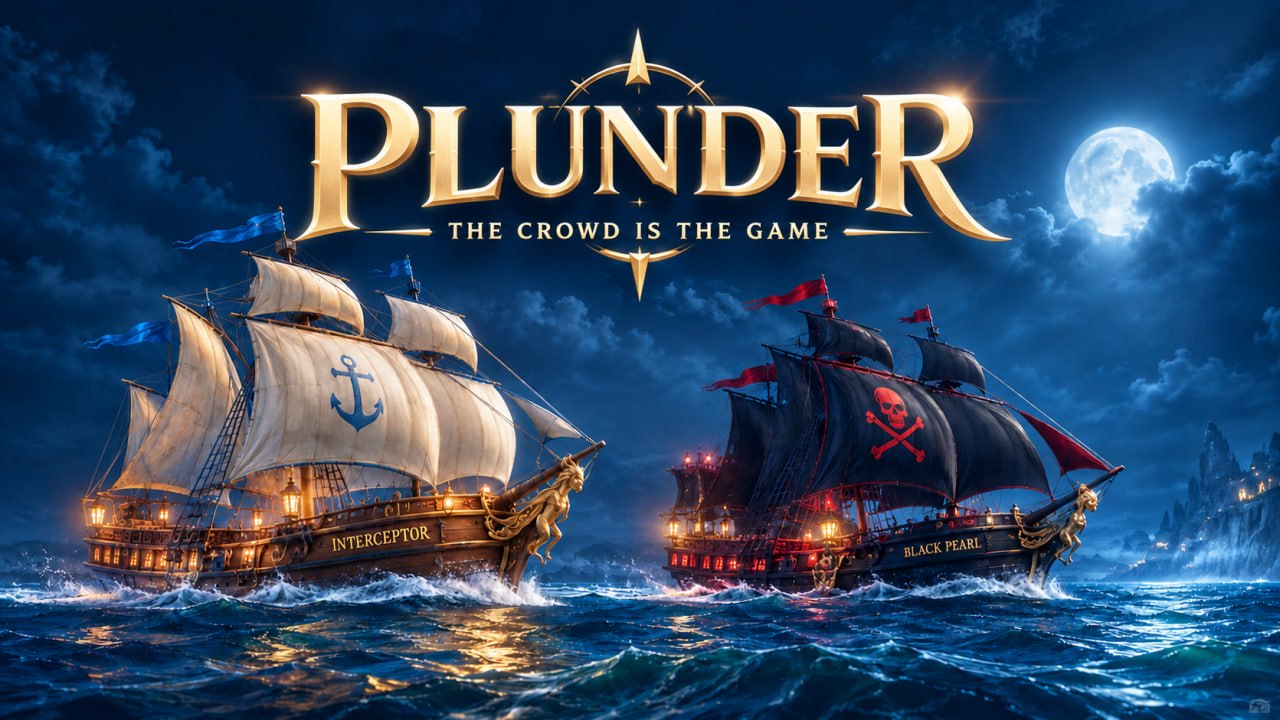
“The crowd is the game.”
Two ships race, the lighter one wins. Bet on the outcome as live-market multipliers shift with the crowd, then jump ship to bank the loot. Every round is shared, fast, and driven by how the crowd moves.
A pari-mutuel crash game pools every player's stake and pays the winners from the losers, instead of the house paying out. Vinco's Plunder applies this to a fast two-ship race: the ship carrying fewer players wins, and its players share the losing pool. The house takes a 5% fee from the losing pool, for a 97.5% RTP. It is the same pooled model behind all pari-mutuel gambling, applied to a crash-style round.
In pari-mutuel betting (also written parimutuel, and also called pari-mutuel wagering), all stakes on an event go into a shared pool. When the result is in, the operator takes a fixed fee and the rest of the pool is divided among the winning bets in proportion to their size. It is the model long used for horse racing totes.
The key difference from fixed-odds or house-banked games is who pays: winners are paid from the other players' stakes, so the operator's revenue is the fee, not the players' losses.
That makes Plunder a peer-to-peer betting game: a pari-mutuel casino game in which players bet against each other rather than the house. It brings online pari-mutuel betting, long familiar from horse racing, into a short round that runs in the browser.
During a 10-second Boarding window, players stake on the Black Pearl or the Interceptor. Crew counts are hidden from everyone.
A 5-second Fog window lets players switch ships or hold. This is the mind game: is your ship too crowded?
The ship with fewer players wins. The losing pool, minus a 5% fee, is shared among the winners in proportion to their stake.
Example (illustrative numbers): if the losing ship holds 1,000 in stakes, the house fee is 50 and 950 is shared among the winners. A player who staked 10% of the winning ship's total gets their stake back plus 95.

“The crowd is the game.”
Two ships race, the lighter one wins. Bet on the outcome as live-market multipliers shift with the crowd, then jump ship to bank the loot. Every round is shared, fast, and driven by how the crowd moves.
| Pari-mutuel (Plunder) | House-banked crash (e.g. Diver) | |
|---|---|---|
| Who pays winners | Players on the losing ship | The house |
| What decides the round | Which ship has fewer players | A crash point fixed before the round |
| House revenue | 5% of the losing pool | The house edge built into the multiplier |
| RTP | 97.5% | Set by the game (Diver: 96%) |
| Role of RNG | None in deciding the winner | Generates the crash point |
| Player interaction | Central: the crowd is the game | Shared round, independent decisions |
Glossary: Pari-mutuel · House edge · RTP (return to player)
Pari-mutuel betting pools all stakes together. After the result, the operator takes a fixed fee and the rest of the pool is shared among the winners in proportion to their stakes. Players win from each other, not from the house.
Yes. Parimutuel, pari-mutuel betting, pari-mutuel wagering and pari-mutuel gambling are names for the same pooled model: all stakes go into one pool, the operator takes a fixed fee, and the rest is shared among the winners in proportion to their stakes.
A pari-mutuel crash game uses that pooled model inside a fast, round-based game. In Vinco's Plunder, two ships race and the stakes on the losing ship become the pool for the winners.
In a house-banked crash game the house pays winners and a hidden crash point decides the round. In Plunder the losing players' stakes pay the winners, the house only takes a 5% fee from the losing pool, and the crowd's choices decide the result.
97.5%. The house takes 5% of the losing pool; winners' stakes are not charged.
Yes. No RNG decides the winner, and every round is published as a public block that can be verified. See provably fair.
Let's talk about bringing original games to your players.
Partner with us